
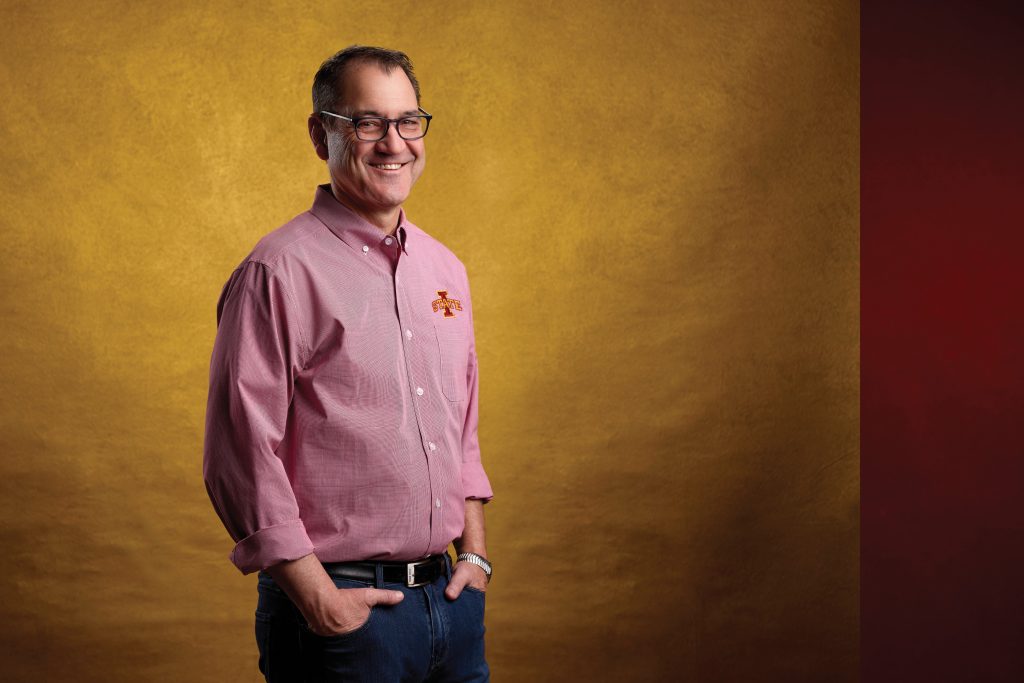
When David Cook walks across Iowa State University’s central campus, it still feels familiar.
The Campanile. The Memorial Union. The sidewalks stretching between Beardshear Hall and Curtiss Hall. For Iowa State’s 17th president, the path back to Ames is more than a career milestone, it is deeply personal.
Cook officially began his presidency on March 1, returning to the university where he earned his degree in 1992 and where he first discovered the power of higher education. An Ames native and graduate of Ames High School, Cook now leads one of the nation’s premier land-grant universities after spending nearly four years as president of North Dakota State University.
Despite decades of administrative leadership experience, Cook insists his return to Iowa State was never part of some carefully constructed career blueprint.
“I never had this idea of coming back to Ames or being the president of Iowa State,” Cook said in an interview with Iowa Stater magazine. “That was never a goal.”
Still, there is a sense throughout campus and the broader community that Cook’s arrival feels uniquely fitting. He’s a leader shaped by Iowa State’s culture now returning to guide its future.
A Land-Grant Mindset
Cook’s professional path has taken him through nearly every level of higher education leadership. Over the course of more than 25 years, he built experience in strategic planning, fundraising, student success initiatives, athletics, government relations, research growth, and financial stewardship.
Those experiences ultimately led him to the presidency at North Dakota State University, another land-grant institution with strong agricultural roots and a growing research profile. That background matters.
Throughout his early months at Iowa State, Cook has repeatedly emphasized the importance of the university’s land-grant mission. To him, it is not as a slogan, but a responsibility. “We’re a land-grant institution, which means we care about the entire state, including the role we have for the state’s workforce,” Cook said in an introductory Q&A published by Inside Iowa State.
That perspective aligns naturally with Iowa State’s longstanding role as an engine for innovation, research, entrepreneurship, and workforce development across Iowa.
Cook has spoken extensively about the need for universities, businesses, and communities to work together more intentionally. He emphasized that Iowa State’s future success will continue to depend on strong partnerships with industry and the ability to prepare students for a rapidly evolving economy.
He sees higher education not as operating separately from the private sector, but as deeply interconnected with it. “I’m a big believer that higher education needs to work with business and industry,” Cook said. “When you blend the academic piece with workforce needs learning, our students leave here well prepared.”
That collaborative approach is expected to resonate strongly throughout the Ames region, where Iowa State serves as both a global research university and a powerful economic driver.
Listening Before Leading
Rather than arriving with promises of dramatic change, Cook’s early strategy has focused heavily on listening. He entered the presidency with what he described as a detailed “100-day plan,” centered on meeting faculty, staff, students, alumni, legislators, and community leaders. “In that plan, I’m going to get out there and do a lot of listening, a lot of learning,” Cook said.
That approach reflects a leadership philosophy Cook often describes as servant leadership, one rooted in collaboration, accessibility, and honest dialogue. He has repeatedly emphasized the importance of surrounding himself with people willing to challenge ideas and offer differing perspectives.
“I want to surround myself with people who are smarter than me, but also who have diverging opinions,” Cook said. “That’s going to make decisions overall a lot stronger because they’re going to be challenged.”
The emphasis on collaboration appears intentional at a moment when higher education institutions across the country face growing pressure to evolve. Universities are navigating questions surrounding artificial intelligence, workforce readiness, affordability, enrollment shifts, political scrutiny, and the future value of higher education itself.
Cook believes Iowa State is exceptionally well positioned to lead through that change. “There are outcomes, metrics, stories that tell you Iowa State is in a very good place,” he said. “So, I want to build on that, rather than reinvent anything.”
Innovation and Opportunity
If there is a defining theme emerging from Cook’s early presidency, it may be innovation.
Again and again, Cook returns to the idea that universities must continuously adapt and challenge themselves. “The world is changing. AI is the latest example, and we want to lead,” he said.
For Cook, innovation is not limited to entrepreneurship programs or startup culture. He sees it as a mindset that should exist across every discipline and classroom.
“Innovation doesn’t have to have an entrepreneurial angle to it,” he said. “I think it’s challenging people to grow and think differently every day.”
That philosophy mirrors many of the conversations already happening across the Ames region as business leaders, educators, and entrepreneurs work to position central Iowa for long-term economic growth. Cook also understands Iowa State’s broader role in talent retention.
As Iowa communities compete nationally for workforce growth, universities increasingly serve as critical pipelines for skilled graduates and future business leaders. Cook has spoken about the importance of experiential learning, industry partnerships, and helping students graduate career-ready.
Those priorities align closely with the university’s strategic plan, which Cook has praised as “thoughtful and comprehensive.” Rather than introducing an entirely new direction, he has suggested the institution will continue evolving and building upon existing momentum.
That continuity matters for a university currently experiencing strong enrollment, expanding research activity, and growing national visibility.
A Personal Return
While much of the conversation around Cook understandably focuses on leadership and strategy, there is another dimension to his presidency that resonates deeply with the Iowa State community: authenticity.
Cook is not learning Iowa State from a distance. He lived it. He remembers being a first-generation college student arriving on campus. He remembers walking central campus as a student. He remembers the people and places that shaped his experience.
“To think that I was going from there to where I am now, I think I’d be pretty surprised,” Cook said. That perspective appears to shape how he and his wife, Katie, are approaching their return to Ames.
The Cooks have already made a point of attending campus events, meeting students in dining centers, and immersing themselves in university life. Katie Cook, also an Iowa State graduate and Ames native, has spoken openly about wanting her role to feel authentic and student-centered.
Their accessibility has become noticeable early in the presidency.
During the AREA Podcast conversation, Cook spoke warmly about the energy students bring to campus and the importance of being visible and approachable as university leaders. He described some of his favorite moments as the unscripted interactions; the conversations after events, discussions with students over meals, and opportunities to hear directly from faculty and staff. “Showing up for them is important,” Cook said.
That mindset may ultimately define Cook’s presidency as much as any strategic initiative. At a university known for its strong culture and loyal alumni base, relationships matter. Community matters. Presence matters. For David Cook, Iowa State is more than an institution to manage. It is home.